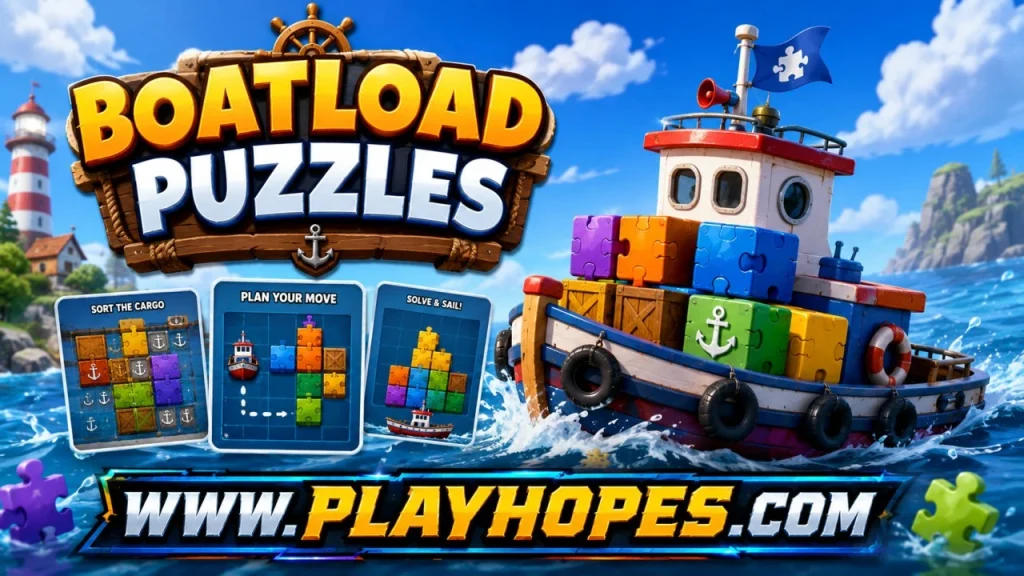




This is the experience of a word puzzle veteran, opening a new puzzle, taking a quick glance and then the answers start coming in. Next, the grid becomes more difficult, the words are cleverly disguised and the flippant method used on the easier puzzles does not work. Boatload puzzles fall into the latter category. They are intended for those who wish to take in a genuine challenge to the mind instead of a excellent win and comprehending their building is the first step to solving them regularly and well.
What Makes Boatload Puzzles Different From Standard Word Games ?
The name alludes to the sheer number and diversity of puzzle content Boatload puzzles have an abundance of word search, crossword and vocabulary challenges that evolve in difficulty and keep even veteran puzzle fans entertained well beyond the shelf life of easier puzzle games.
The setting of the grid in this format is deliberately complicated, distinguishing it from the basic word games. Words are not randomly arranged, but overlap in interesting ways, share letters and letters for words, and create intentional visual clutter so that isolated scanning is not effective. If you read a puzzle like a word search, you will never find words in the boatload because the puzzle is designed to elicit a new type of reading strategy.
Knowing that difference will make all the difference in the way you approach each and every puzzle.
Practical Strategies That Improve Results
Start With Uncommon Letters
The first thing to look for is letters that don’t occur a lot in English, such as Q, X, Z, J, and K; before reading a word from the word list, look for their low frequency in English across the entire grid.
Knowing those anchor points first allows you to have stable points to start from. A Q in position 4 row 7 indicates exactly where words with a Q should go and there are not too many words with a Q in any standard word list to match.
Work the Word List From the Bottom
When it comes to reading, people will tend to read top to bottom in the word list. This is taken into consideration by the creators of the grid and words are placed in the top row which are easier and shorter, words that can be solved easily meaning that you have a false sense of achievement before you can really get to grips with the real difficulty.
The shorter, easier to find words are the last ones that will be used, so you start them at the bottom of the word list, when you are most focused and the grid is not yet “dirty” with circled words. Earliest finding of a 9 letter diagonal word is much easier than finding it after 40 minutes of scanning for words to make attention harder.
Use Letter Clusters as Anchors
In boatload puzzles there are words in the puzzle that are rare in the random letter fill in the grid, such as TH, SH, CH, QU, PH and more. Identifying the clusters instead of the words allows for a more rapid initial scan and a more confident letter matching than would be obtained by attempting to match words in one pass.
How Playing Other Puzzle Games Improves Your Boatload Performance ?
Cognitive abilities that boatload puzzles build are applicable to all types of puzzles and the diverse puzzle games reinforce each skill.
➜ Kitty Drop 3D is the same spatial awareness that is required for diagonal word scanning. When the brain is trained to anticipate what will happen to a falling object after it encounters obstacles, it will learn how to track multiple directions at once, which is what diagonal word finding is faster in a grid.
➜ Color Block Out is a training program that builds up a quick pattern recognition, a key element to efficient grid scanning. The visual processing system that is used when performing colour cluster under time pressure is the same as the one used in word puzzles solving, and the speed with which this recognition occurs is measurably better with regular performance.
➜ Farming Mini Puzzle on Playhopes is especially important for those who have difficulty with sequential thinking used in long word searches. The puzzle layout requires a good degree of foresight, instead of just acting on what is in front of you and this will help to enhance strategic thinking when you encounter more difficult Boatload puzzle layouts, where the solution is not always visible in the first square you pick.
➜ Cargo Captain offers you a game where you will have to make a well informed decision but one that you can make at a leisurely pace. Making a rush delivery in that game is the same as rushing a grid scan, and it creates mistakes that will need to be made up later and take longer to do than it takes to be patient and study the grid.
➜ Bear Go Home trains path finding logic in an easily accessed but gradually challenging format. The ability to find the right way through an intricate landscape and to systematically rule out things that would not fit the cognitive skill of eliminating things that can’t be is structurally the same as the ability to narrow down where a hidden word has to fit in a dense grid.
There is no download, no sign up, simply open and play these 5 directly in your browser.
Building a Consistent Puzzle Solving Routine
Improvement at boatload puzzles does not come from playing more it comes from playing more deliberately. The players who improve fastest are the ones who approach each grid with the same systematic method rather than switching strategies based on how easy or difficult the first few words feel.
A repeatable solving routine that works:
- Scan the full grid before attempting any word from the list.
- Identify all uncommon letter positions first and mark them.
- Begin the word list from the bottom rather than the top.
- Use letter cluster scanning rather than full word scanning on initial passes.
- Reserve horizontal scanning for the final pass when all other directions have been checked.
Following this sequence consistently produces faster completion times within five to ten puzzle sessions not because the puzzle games become easier, but because the approach becomes automatic rather than effortful..
The Bottom Line
Boatload puzzles are hints to the players, for whom the idea of a grid that doesn’t ‘give away’ the puzzle is a clever move. Each of the above strategies is not a quick fix but an adjustment to the system that will yield results when used in repeated sessions.
The skills to be developed are indeed important cognitive skills. The diversity of the type of puzzles you’ll see in Playhopes also means that when one type becomes easy, you can always move on to another puzzle type, another arrangement, another grid, and another word you’ll need to locate in the direction you hadn’t expected.