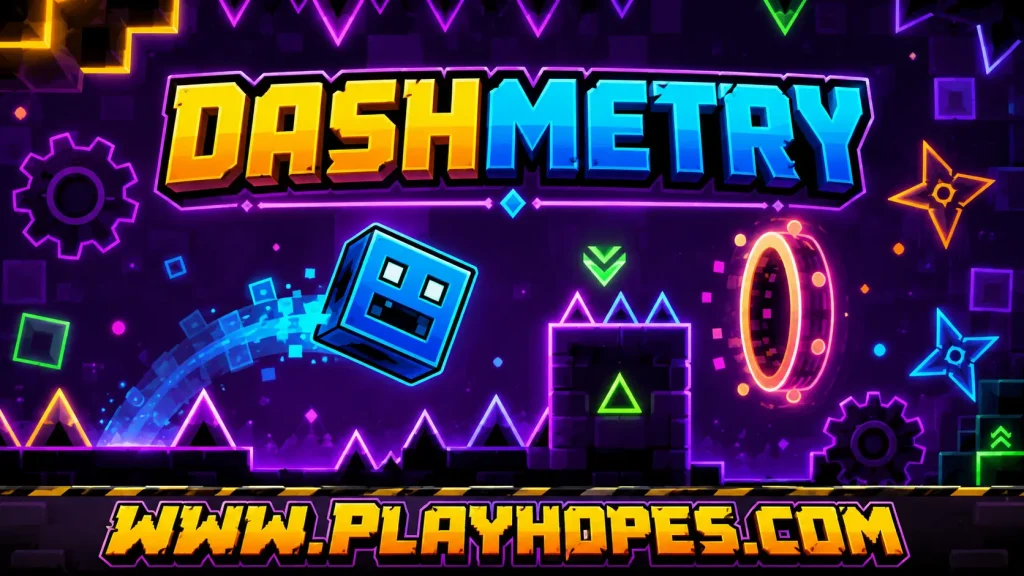




Dashmetry a rhythm driven platformer that tests your reflexes against the beat of the music itself. If you’ve never played a music synced platformer before, it can feel intense within the first few seconds, your character moves automatically, and your only real job is deciding exactly when to jump. This guide covers what Dashmetry actually is, how the core mechanics work, and a handful of practical tips to help you get further with fewer frustrating restarts.
What Is Dashmetry?
Dashmetry is a rhythm based platformer where your character runs forward automatically through a level filled with spikes, saws, gears, and shifting obstacles, while the music dictates the timing of everything happening on screen. Every jump, flight, and gravity flip is designed to sync with the beat, which means success depends less on quick, random reactions and more on genuinely feeling the rhythm of each level.
The controls themselves are intentionally simple, usually just a single button, whether that’s a spacebar, click, or tap. What makes the game demanding isn’t the number of inputs, it’s the precision required behind each one. A single mistimed tap sends you straight back to the start, which is exactly what makes finally clearing a difficult section feel so satisfying.
How the Core Gameplay Works?
Since your character moves forward on its own, Dashmetry shifts the challenge entirely onto timing rather than movement control. Understanding a few core mechanics makes the learning curve much easier to manage.
- One-button controls jumping or interacting with obstacles typically uses a single key or click.
- Portals that change your form passing through certain portals transforms your character, altering how it moves and responds.
- Gravity flips some sections reverse gravity entirely, requiring a quick mental adjustment mid run.
- Music-synced obstacles spikes, saws, and gaps are timed to match the track, rewarding players who move with the rhythm rather than against it.
- Instant restarts failing a section sends you back to the beginning, but restarts are quick, keeping the pace of practice fast.
Because your character can transform mid level through different movement modes, no two stretches of a level necessarily play the same way, keeping the pace unpredictable even after multiple attempts.
Tips to Improve Your Dashmetry Runs
If you’re struggling to get past a particular section, a few practical habits tend to make a noticeable difference over time:
- Start with easier difficulty levels first, since Dashmetry typically offers a range from beginner friendly stages up to much harder challenges.
- Play with sound on, since the music isn’t just background, it’s the actual timing cue for most obstacles.
- Focus on one section at a time rather than trying to memorize an entire level in one sitting.
- Use fullscreen mode if available, since a larger play area makes timing windows easier to judge.
- Expect repetition, since improvement in rhythm platformers usually comes from repeated attempts rather than one lucky run.
Treating each failed attempt as a small step toward learning the pattern, rather than a setback, tends to make the whole experience far less frustrating.
Why Timing Matters More Than Speed?
A common mistake newer players make is assuming faster reactions alone will carry them through Dashmetry. In reality, the game rewards rhythm over raw speed. Jumping slightly early or late, even by a fraction of a second, is often just as much of a mistake as not jumping at all.
- Listen for patterns in the music rather than reacting purely to visual cues.
- Anticipate upcoming obstacles based on the beat, rather than waiting to see them appear.
- Adjust your internal timing whenever gravity flips or your character’s form changes.
- Stay calm after a failed attempt, since tension often leads to rushed, mistimed jumps.
Once timing starts to click with the rhythm, sections that once felt impossible often become manageable simply through better anticipation rather than faster fingers.
Taking a Break Between Runs
Rhythm platformers like Dashmetry demand a lot of sustained focus, and pushing through repeated failures without pausing can actually make timing worse rather than better. If a section keeps beating you, stepping away for a few minutes with something completely different, like a quick round of Fruit Slicer Fun can reset your focus before jumping back in with a clearer head.
If You Enjoy Fast, Reflex Driven Games
Dashmetry appeal largely comes from how demanding its timing is, and if that kind of fast paced challenge is what draws you in, a few other categories are worth exploring as well. Snow Ball Race offers a similarly quick reaction style of gameplay, just built around momentum and obstacles rather than music. Similarly Roblox Run 3d leans into fast, continuous movement, making it a natural pick for players who enjoy the same sense of forward momentum that defines Dashmetry.
When You Want Something Slower
Not every gaming session needs the same intensity as a Dashmetry run. For players who want to shift gears entirely, Monopoly Online offers a much slower, strategy driven pace built around planning rather than split second timing. On the chaotic end of the spectrum but without music based precision, House of hazards brings a different kind of unpredictable challenge, one built around physical obstacles rather than rhythm.
Final Thoughts
Dashmetry isn’t a game you master through quick reflexes alone it’s one you learn through rhythm, pattern recognition, and a willingness to keep trying after inevitable early failures. Once the timing starts to click, the same obstacles that felt impossible a few attempts earlier start to feel like second nature. Whether you’re new to rhythm platformers or already a fan of the genre, platforms such as atmhtml5games can make it easy to discover games like Dashmetry while playing free on Playhopes lets you jump in, fail fast, and keep chasing that next successful run.